
The Challenge
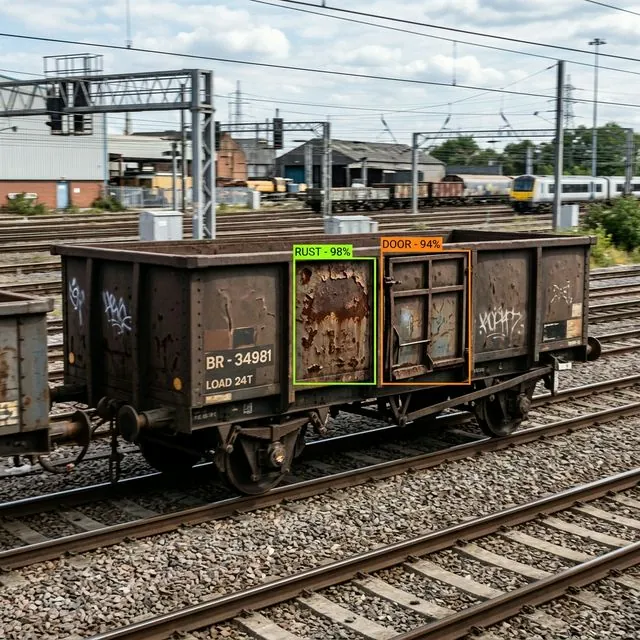
Overheated axle bearings — commonly called "hot boxes" — are one of the most dangerous and costly failure modes in railway operations. A bearing that runs too hot can seize, derail a wagon, and cause catastrophic damage to rolling stock, track infrastructure, and in the worst cases, human life. The industry has been battling this problem for over a century.
Our client, a national railway freight operator running over 1,200 wagons across a 4,500+ km network with 15 maintenance depots, was relying on a legacy approach: wayside hot-box detectors (HBDs) installed at fixed trackside intervals that scan passing axles with infrared sensors. While these detectors catch some overheating events, they have significant blind spots — they only measure temperature at the exact moment a wagon passes the sensor, and sensors are spaced 30–50 km apart. A bearing that starts overheating between two detectors can go unnoticed for dangerous stretches.
The consequences were severe. The operator was experiencing an average of 8–10 unplanned en-route stoppages per month due to axle-related thermal events. Each incident resulted in 4–6 hours of line disruption, cascading delays across the network, emergency maintenance crew dispatches, and in some cases, damaged track sections requiring expensive repairs. The direct and indirect cost of these incidents was estimated at ₹3.5 Cr annually.
The operator needed a system that could monitor every axle, continuously, in real-time — not just at fixed waypoints — and alert maintenance teams before a bearing reaches critical temperature, not after.
Our Solution
AdaptNXT designed and deployed an end-to-end IoT-based continuous axle temperature monitoring system that replaces reactive detection with proactive, real-time intelligence:
- On-Axle IoT Sensor Modules: Engineered ruggedised, vibration-resistant sensor units mounted directly on axle bearing housings. Each module integrates a high-precision infrared temperature sensor, a 3-axis accelerometer for vibration profiling, and an onboard microcontroller — rated for IP67 ingress protection and operating temperatures from -20°C to +85°C.
- Low-Power Wireless Mesh Network: Deployed a wagon-level wireless mesh network using LoRa (Long Range) radio, enabling sensor data from every axle on a rake to relay to a central gateway unit mounted on the brake van. The mesh topology ensures reliable data transmission even on rakes exceeding 50 wagons, with ultra-low power consumption enabling 18+ months of battery life per sensor.
- Edge Gateway with On-Board AI: Built a ruggedised edge computing gateway that aggregates sensor data from the entire rake, runs lightweight anomaly detection models (TinyML) locally, and transmits compressed telemetry to the cloud via 4G/LTE. Critical alerts — such as a bearing exceeding thermal thresholds — are generated at the edge in under 2 seconds, even without cloud connectivity.
- Cloud-Based Predictive Analytics Platform: Developed a centralised cloud platform (AWS IoT Core + TimeStream + SageMaker) that ingests continuous telemetry from the entire fleet, trains gradient-boosted and LSTM models on historical thermal profiles, and predicts bearing degradation 7–14 days in advance based on progressive temperature drift patterns invisible to threshold-based systems.
- Real-Time Operations Dashboard & Alert System: Created a live fleet monitoring dashboard showing axle-level thermal status across every wagon in the network, with colour-coded risk tiers (Normal → Watch → Warning → Critical). Automated escalation alerts are pushed via SMS, WhatsApp, and the dashboard to control room operators, depot maintenance heads, and loco pilots based on severity.
- Maintenance Integration & Digital Logbook: Integrated the platform with the operator's existing depot maintenance scheduling system, automatically generating predictive work orders for bearings flagged as degrading. A digital axle health logbook replaces paper-based inspection records, giving every bearing a traceable thermal history.
- Phased Deployment with Validation: Ran a 120-day pilot on 3 high-traffic routes covering 200 wagons, instrumenting 1,600 axles. Validated detection accuracy against existing HBD readings and manual thermography inspections before scaling to full-fleet deployment across all 15 depots.
The Impact
The results from the first six months of full-fleet deployment demonstrated a step-change improvement in safety, reliability, and maintenance economics:
- 60% reduction in unplanned en-route stoppages due to axle thermal events — from an average of 8–10 per month down to 3–4, with the remaining incidents caught and managed proactively before reaching critical severity.
- Estimated ₹2.1 Cr in annual savings from avoided emergency maintenance dispatches, reduced track damage, and elimination of cascading schedule delays across the network.
- 14-day predictive lead time on bearing degradation — the ML models successfully flagged 87% of bearings that would have failed within two weeks, enabling planned depot-level replacement during scheduled maintenance windows.
- 100% axle visibility across the fleet — replacing the legacy system's intermittent, waypoint-only coverage with continuous, real-time monitoring of every bearing on every wagon in operation.