
In the marketing materials of SaaS companies, the terms "Predictive Analytics," "Machine Learning," and "Artificial Intelligence" are thrown around interchangeably. They treat them as synonyms for "software that uses a lot of math to sound smart." For business leaders tasked with allocating technology budgets, this deliberate vagueness is dangerous.
These disciplines are related, but they are not the same. They require different teams, different computational power, and they answer entirely different types of business problems. Understanding the technical distinction is the only way to avoid buying an unnecessarily complex solution for a simple problem—or vice versa.
The TL;DR Definition
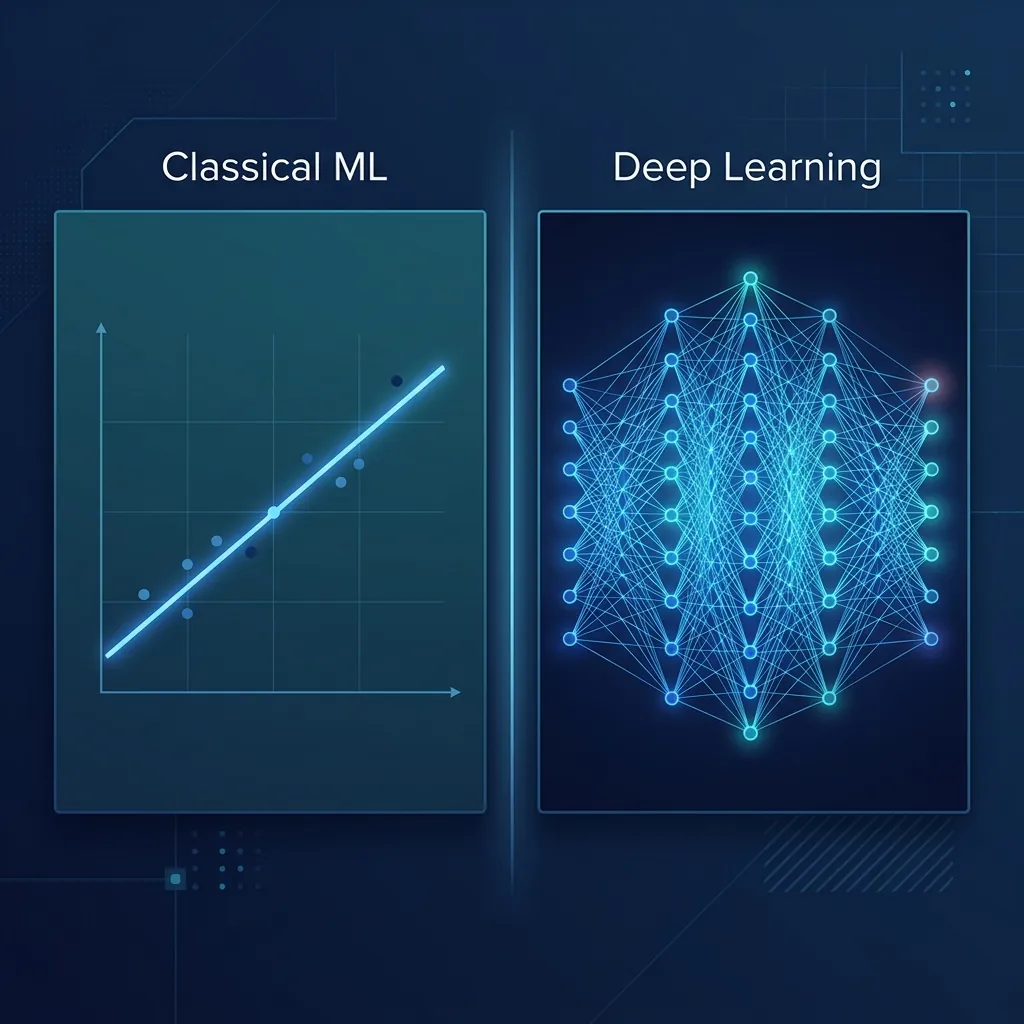
Predictive Analytics is mostly a statistical discipline. It uses historical data and mathematical formulas (usually established by a human analyst) to calculate the statistical probability of a future event based on known variables.
Machine Learning is a computational discipline branching from AI. It involves feeding massive amounts of data into an algorithm, allowing the algorithm to figure out the mathematical formula itself, and then continuously update its own logic as new data flows in.
Predictive Analytics: Human-Led Statistics
At its core, predictive analytics looks at the past to predict the future using rigid statistical models—most commonly, regression analysis (linear or logistic).
In predictive analytics, the human data scientist acts as the architect. The human looks at the business problem and says, "I believe that customer churn is influenced by three variables: how many support tickets they submitted, when their contract expires, and whether they logged in last week." The human writes the statistical model linking those specific variables, runs the historical data through the equation, and the software outputs a probability score for each customer.
When to use Predictive Analytics:
- When you have a limited number of well-understood variables (e.g., pricing, seasonality, basic demographics).
- When the rules governing the business problem rarely change.
- When stakeholders demand "explainability." Because a human wrote the statistical model, the human can explain exactly why the software predicted a certain outcome. If a loan is denied, the bank can point directly to the specific variable in the formula that caused the denial.
Machine Learning: Algorithm-Led Pattern Recognition
Machine Learning removes the human architect from the variable-selection process. Instead of a human guessing which three variables matter, the human feeds the algorithm 5,000 different variables and says, "Here is all the historical data, and here are the customers who churned. You figure out the pattern."
The ML algorithm might discover that churn is heavily correlated with a deeply non-obvious combination of factors: customers who logged in on a Tuesday, bought the mid-tier package, and live in climates that experience heavy rainfall. A human statistician would never think to write a formula connecting local weather to software churn, but an ML model using Random Forest or Neural Networks will find that hidden correlation.
Crucially, an ML model learns. As market conditions change, the model continuously ingests the new data, recognizes that the old patterns are failing, and rewrites its own internal weighting to maintain accuracy without a human having to manually update the code.
When to use Machine Learning:
- When dealing with unstructured data. Predictive analytics cannot analyze photographs, read unstructured emails, or transcribe voice calls. Deep learning ML models excel at this.
- When the variables are too numerous or complex for human comprehension (e.g., dynamic pricing on an e-commerce platform adjusting 10,000 SKUs in real-time based on competitor scraping and inventory micro-fluctuations).
- When the environment is highly dynamic and human analysts cannot rewrite statistical formulas fast enough to keep up with changing reality.
The Trade-Off: Accuracy vs. The Black Box
If Machine Learning is more powerful, why use traditional Predictive Analytics at all?
The answer is the "Black Box" problem. The more complex an ML model becomes (particularly deep neural networks), the less explainable it is. The model might predict with 99% accuracy that a specific component in an airplane engine will fail in 14 hours. But if you ask the model why it made that prediction, the mathematical pathway is often too complex for a human to decipher.
In highly regulated industries (finance, healthcare, insurance), regulators often forbid the use of "black box" models for critical decisions like loan approvals or medical diagnoses because the corporation cannot legally explain the rationale behind a denial. In these scenarios, the transparent, human-auditable math of traditional predictive analytics remains superior.
Understanding which tool fits the job prevents massively expensive missteps. Speak with the data scientists at AdaptNXT to map your business objectives to the correct, most cost-effective architectural approach.