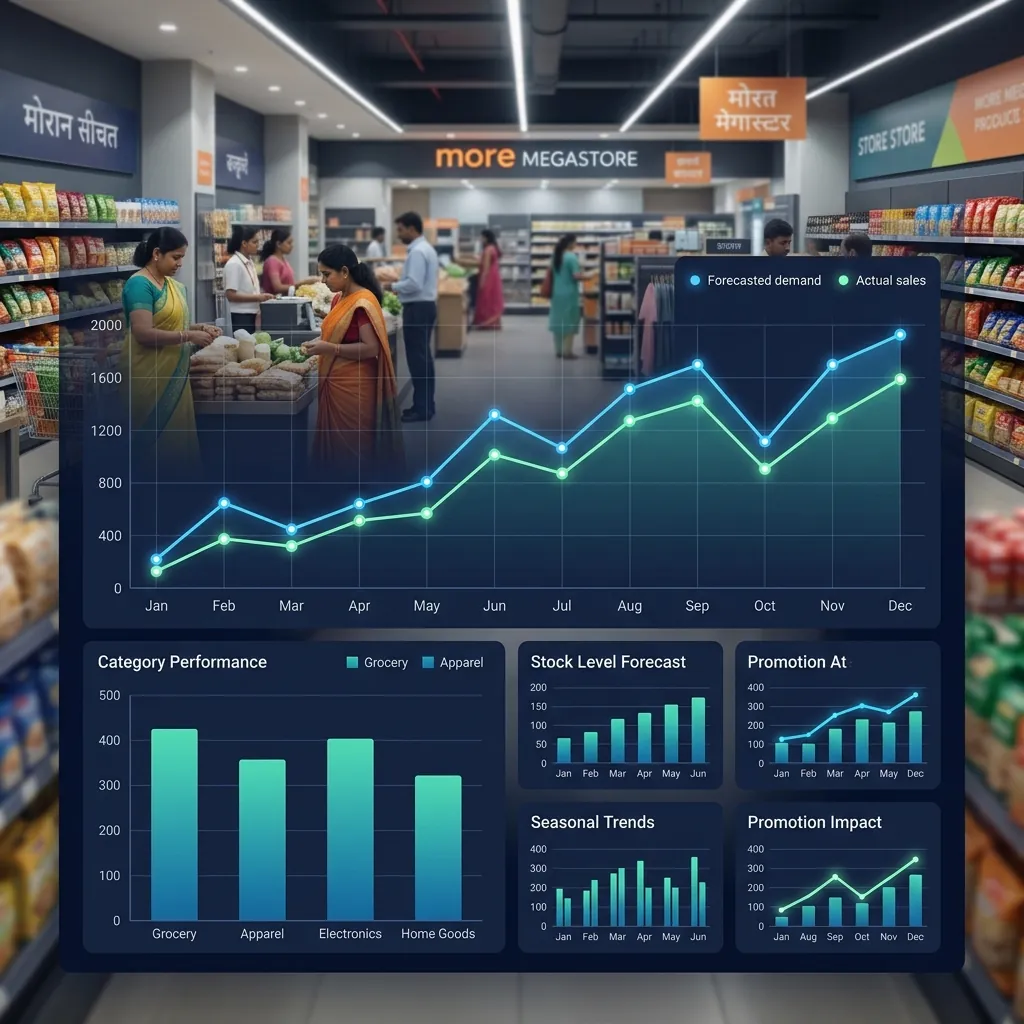

The "arms race" for complexity in AI often leaves business leaders wondering: do we actually need a deep learning solution, or is a simpler model better? In the field of business forecasting—where we predict everything from monthly revenue to inventory levels—the answer is rarely "more is better." It is about matching the model to the data, the decision, and the constraints.
This guide breaks down the two main approaches to business forecasting and provides a decision-making framework for data leaders.
1. Classical Machine Learning: The Reliable Foundation
Classical machine learning, which includes statistical models like ARIMA/SARIMA and ensembled methods like Random Forests or XGBoost, has been the backbone of business forecasting for decades. These models excel in certain contexts:
When to Use Classical ML:
- Limited Data: If you have only a few years of monthly sales data, classical models are far more robust. Deep learning requires massive amounts of data to avoid overfitting.
- Interpretability is Paramount: If a business decision requires an explanation—"Why is the forecast for next month up 10%?"—classical models like Linear Regression or Decision Trees provide clear, human-readable insights.
- Tabular, Static Features: If your forecasts are based on well-defined features like price, holidays, and competitor spend, XGBoost is often hard to beat in terms of accuracy and speed.
2. Deep Learning: The Powerful Expert
Deep learning architectures, such as Long Short-Term Memory (LSTM) networks, Temporal Convolutional Networks (TCNs), and the more recent Time-Series Transformers, represent the cutting edge. They are capable of capturing extremely complex, non-linear relationships and long-range dependencies.
When to Use Deep Learning:
- Massive Data Volumes: If you are a high-volume retailer with millions of daily transactions across thousands of SKUs, deep learning can extract patterns that classical models miss.
- Complex, Intersecting Time-Series: When the demand for one product is highly correlated with dozens of others (cross-correlation), neural networks can model these intricate relationships effectively.
- Inherent "Memory" Requirements: LSTMs are specifically designed to "remember" long-term trends while "forgetting" short-term noise, making them ideal for capturing complex seasonal cycles that simpler models might ignore.
The Comparison Table
| Feature | Classical ML | Deep Learning |
|---|---|---|
| Data Required | Low to Moderate | Very High |
| Interpretability | High (White-Box) | Low (Black-Box) |
| Compute Power | Low (Runs on CPU) | High (Requires GPU) |
| Training Time | Fast (Seconds/Minutes) | Slow (Hours/Days) |
Conclusion: The "Hybrid" Future
In 2026, many of the most successful forecasting systems are actually hybrids. An ensemble approach might use a classical model for the "baseline" trend and a deep learning model to capture "residual" complexity—providing a forecast that is both accurate and interpretable.
AdaptNXT data science team helps businesses architect the optimal forecasting system that matches their unique data landscape. Connect with us to evaluate your current forecasting models.