
The conceptual business case for Artificial Intelligence is ironclad: it increases output, reduces human error, and slashes operational costs. Yet, industry surveys consistently show that an alarming number of enterprise AI proofs-of-concept (POCs) never make it into production. The technological capability exists, but the deployment fails.
Why? Because deploying AI is not an IT project; it is a fundamental organizational transformation. The barriers to success are rarely algorithmic. They are structural, cultural, and political. Here are the top five challenges enterprises face when adopting AI, and how to overcome them.
1. The "Garbage In, Garbage Out" Data Problem
The Challenge: A company purchases a multi-million dollar Machine Learning platform to predict customer churn. Six months later, the predictions are wildly inaccurate. Leadership blames the AI vendor. The reality? The AI was trained on a CRM database filled with duplicate records, incomplete fields, and biased historical decisions.
The Solution: You cannot sprint to AI without walking through data engineering first. Before licensing software, organizations must mandate a "Data Readiness Phase." Use our AI Data Readiness Checklist to audit your existing infrastructure. This involves breaking down data silos, establishing strict data governance protocols across departments, and building clean, centralized data lakes. If your data is a mess, spend your AI budget on data engineers first.
2. Employee Resistance and the Fear of Replacement
The Challenge: When leadership announces the integration of an AI tool designed to "maximize efficiency," employees translate that to "this robot is going to take my job." Consequently, employees will quietly sabotage the deployment. They won't use the tool, they'll feed it bad data, or they'll highlight its errors to prove human superiority.
The Solution: The narrative must shift from "Replacement" to "Augmentation." Change management is critical. Frame the AI as a junior assistant that handles the mind-numbing, repetitive parts of the job (like data entry or parsing 50-page PDFs), freeing the employee to focus on high-value, strategic work. Crucially, involve the end-users in the testing phase so they feel ownership of the tool, not threatened by it.
3. The Black Box and Lack of Explainability
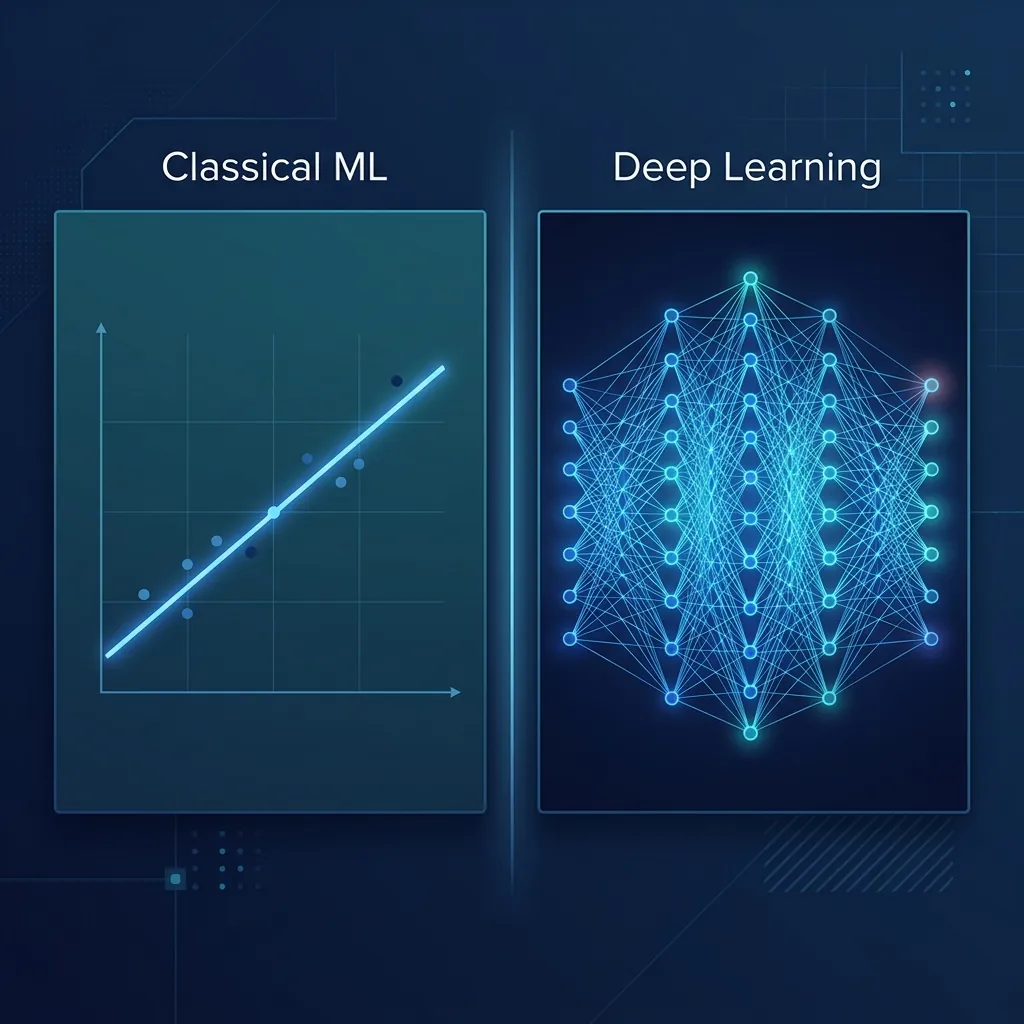
The Challenge: Deep Learning neural networks are incredibly powerful, but their mathematical pathways are often too complex for humans to decipher. If an AI denies a customer's loan application, but the bank cannot legally explain *why* it was denied to regulators, the bank faces massive liability.
The Solution: In highly regulated industries (finance, healthcare, insurance), deploy "Explainable AI" (XAI) models. Sometimes, you must sacrifice the 1% maximum accuracy of a deep neural network in favor of a simpler Random Forest or Logistic Regression model that provides a clear, auditable trail of decision-making for compliance officers.
4. The "Shiny Object" Syndrome
The Challenge: An executive reads an article about Generative AI and mandates that the IT department "implement GenAI immediately." The team scrambles to build a chatbot that nobody asked for, solving a problem that didn't exist, resulting in zero measurable ROI.
The Solution: Never start with the technology; always start with the business problem. Conduct an operational audit to identify the bottlenecks dragging down profit margins. If the biggest bottleneck is supply chain logistics, an LLM chatbot is useless. You need predictive analytics. Map the specific pain point to the specific mathematical solution.
5. Lack of MLOps Infrastructure
The Challenge: A data science team builds a brilliant predictive model on their local laptops. It works perfectly. When IT tries to deploy it to the live cloud environment, connection speeds bottleneck, the model crashes, or its accuracy drifts over time as new, unseen data enters the system.
The Solution: Machine Learning Operations (MLOps) is the missing link. Just as software engineering has DevOps, data science requires MLOps. Establish a dedicated team responsible for moving models from the lab into production, monitoring them for "model drift," and building automated pipelines to constantly retrain the AI on fresh data so it doesn't become obsolete.
Successful AI adoption is an exercise in strategic planning, not just software licensing. Begin by taking our AI Readiness Assessment to identify your organization's technical and cultural gaps. Then, partner with AdaptNXT's consulting team to build a roadmap that guides your organization past these enterprise roadblocks.