
The Challenge
Farmers and environmental researchers in the USA often face significant challenges in collecting and interpreting fragmented data across soil, water, and weather parameters. Manual monitoring is not only labor-intensive but also prone to errors, leading to inefficient water usage, increased crop health risks, and delayed responses to rapidly shifting weather patterns.
Our client needed a centralized solution that could bridge the gap between field-level data collection and high-level academic or administrative analysis. Administrators lacked a unified portal to oversee regional agricultural health, while universities required high-granularity data for science-based research and predictive modeling.
The core requirement was a robust, scalable IoT platform—Iris Central—capable of unifying rugged sensor data into actionable insights for diverse stakeholders, from individual farmers to large-scale research institutions.
Our Solution
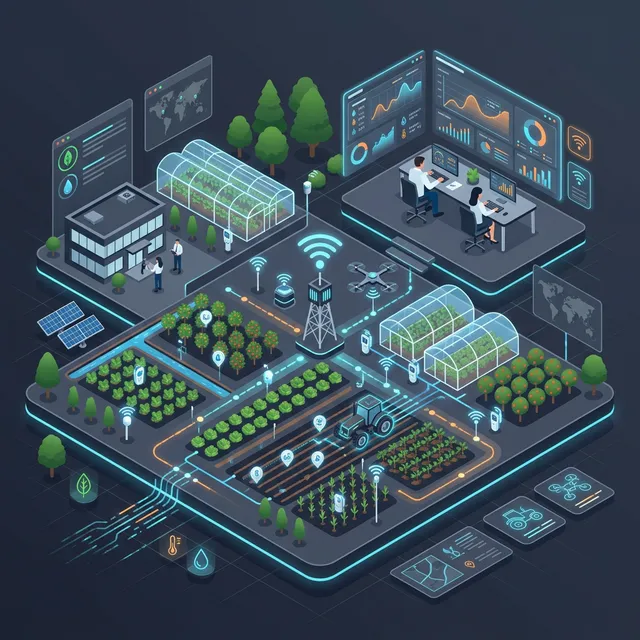
AdaptNXT engineered Iris Central as a multi-layered IoT ecosystem designed for scalability and precision:
- Integrated IoT Portal: Built a unified central portal that aggregates data from ruggedized environmental sensors, utilizing a high-performance wireless network layer for real-time transmission.
- Cross-Platform Mobile Application: Developed an intuitive mobile app for farmers, providing field-level insights on soil moisture, plant health, and local weather alerts directly on their devices.
- Advanced Windows Desktop Application: Created a comprehensive desktop application for universities and administrators, featuring deep-dive science-based analytics and regional environmental trend mapping.
- Automated Action Protocols: Implemented intelligent thresholds to trigger automated actions, such as irrigation systems or protective covering, based on real-time sensor data, reducing manual intervention and human error.
- Multi-Layered Data Visualization: Designed interactive, "at-a-glance" dashboards that transform complex environmental metrics into actionable visual data points for rapid decision-making.
- Scalable Cloud Backend: Developed a high-frequency telemetry processing engine on a scalable cloud infrastructure to manage thousands of distributed sensors across varied US topographies.
- Collaborative Stakeholder Workshops: Conducted iterative discovery sessions with farmers and academic researchers to ensure the platform met both operational field requirements and rigorous scientific standards.
The Impact
Iris Central has significantly improved data-driven decision-making in agricultural operations across the USA:
- 25% increase in land management capacity with the same resource overhead, achieved through centralized monitoring and real-time automated alerts.
- 15% reduction in water consumption across pilot farms by implementing precise, sensor-driven irrigation schedules rooted in real-time soil moisture data.
- Enhanced Predictability and Research: Provided universities with high-granularity environmental data, improving crop yield predictability and enabling more accurate environmental conservation studies.
- Streamlined Administrative Oversight: Reduced regional data reconciliation time for administrators from days to minutes through a unified reporting dashboard.