
Every software product that exists today — from the app on your phone to the system running a hospital — went through a development process to get there. That process determines how quickly the software gets built, how reliable it is, how well it solves the user's problem, and how much it costs to maintain over time. Teams that understand and follow a well-defined development process ship better software, faster, with fewer catastrophic surprises along the way.
This guide covers the core phases of software development and the major methodologies teams use to execute them.
The Core Phases of Software Development
Regardless of methodology, every significant software project moves through the same fundamental phases — the sequence and iteration frequency varies by approach, but the work itself is consistent.
Phase 1: Requirements and Discovery
Before writing a line of code, the team needs to understand what they're building, for whom, and why. This phase involves stakeholder interviews, user research, competitive analysis, and requirements documentation. The output is a shared understanding of what success looks like — what the software must do, the constraints it must operate within, and how it will be measured.
Skipping or rushing discovery is one of the most expensive mistakes in software development. Building the wrong thing with excellence is still building the wrong thing. The cost of changing requirements increases 10x for every phase you wait to surface a misunderstanding.
Phase 2: System Design and Architecture
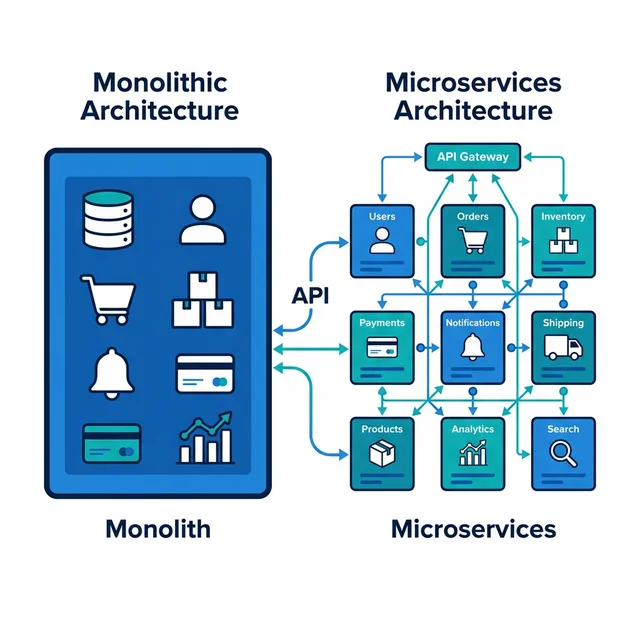
Architecture decisions made early are expensive to reverse later. This phase translates requirements into a technical blueprint: the system's components, how they interact, which technologies and frameworks to use, how data will be modeled and stored, how the system will scale, and how it will be secured.
Good architecture is not creative freedom — it's constraint. It establishes the patterns and principles that all subsequent development follows, enabling a team to work in parallel without creating incompatible components.
Phase 3: Development
This is where the software is actually built. In modern teams, development is rarely a linear march through a feature list — it's an iterative process of building, reviewing, testing, integrating, and refining in short cycles. Code quality practices — version control, code review, automated testing, CI/CD — are active during this phase, not afterthoughts.
Phase 4: Testing and Quality Assurance
Testing is not a phase that comes after development — it's an activity that runs throughout. But dedicated QA effort validates that the software meets requirements, handles edge cases, performs under load, is secure, and works across the environments it needs to support.
- Unit testing: Individual functions and components tested in isolation
- Integration testing: Components tested together to verify interactions
- System testing: The complete software tested end-to-end
- User acceptance testing (UAT): Real users or stakeholders validate against requirements
- Performance testing: How the system behaves under expected and peak load
- Security testing: Penetration testing, vulnerability scanning, compliance validation
Phase 5: Deployment
Getting software from a development environment to production is a process that carries real risk if managed poorly. Modern deployment practices — CI/CD pipelines, blue-green deployments, feature flags, canary releases — make deployment safer, faster, and more frequent. The goal is to make deployment a routine event, not a high-anxiety occasion.
Phase 6: Maintenance and Evolution
Software isn't done the day it ships — it's done when it's decommissioned. The maintenance phase covers bug fixes, security updates, performance optimization, and new feature development. Well-architected systems are maintainable; poorly structured ones accumulate technical debt that eventually stops development cold.
"The most expensive line of code to change is the one that represents an architectural decision made in the first week of the project. Design for change from the start."
Software Development Methodologies
The phases above are the what — methodology is the how. Different methodologies impose different structures, feedback loops, and team dynamics on the development process.
Waterfall
The traditional sequential approach: complete requirements before design, complete design before development, complete development before testing. Each phase has formal sign-off before the next begins. Simple to plan and manage but deeply vulnerable to late-discovered problems — by the time users see the software, changing direction is very expensive. Best suited for projects with stable, well-understood requirements — regulatory systems, embedded firmware, infrastructure software.
Agile
Agile replaced the waterfall approach as the dominant paradigm for most software development because it solves waterfall's most critical failure: the inability to incorporate learning mid-project. Agile organizes work into short iterations (sprints, typically 1–4 weeks) that each produce working software. Stakeholders see working software early and can redirect before months of effort go in the wrong direction.
Agile is a philosophy, not a specific process. Its concrete implementations include Scrum (the most widely used), Kanban (continuous flow), SAFe (scaled for large enterprises), and others.
Scrum
The most widely adopted Agile framework. Key elements: a Product Backlog of prioritized requirements; Sprint Planning to select work for the next sprint; daily Standups to surface blockers; working software at the end of each sprint; Sprint Review and Retrospective to show stakeholders and improve the team's process. Roles are defined: Product Owner (what to build), Scrum Master (how to work together), Development Team (how to build it).
Kanban
A flow-based approach that focuses on visualising work, limiting work-in-progress (WIP), and maximizing flow rate. Unlike Scrum, there are no fixed sprints — work flows through stages (To Do → In Progress → Testing → Done) as capacity allows. Well-suited to operational work, support, and maintenance where task timing is unpredictable.
Choosing the Right Methodology
The right methodology depends on your project's characteristics:
- Requirements are clear and stable: Waterfall or Scrum
- Requirements will evolve: Scrum
- Continuous flow of mixed-priority tasks: Kanban
- Large team, multiple squads: SAFe or LeSS
- Research-heavy product development: Lean Startup + Scrum
What Makes a Software Development Process Work
Methodology accounts for perhaps 20% of project success. The rest comes from: a well-defined problem worth solving; engineers with strong fundamentals; code review and quality standards consistently applied; honest, frequent communication between technical and business stakeholders; and a culture that surfaces problems early rather than managing perceptions until it's too late.
AdaptNXT engineers products across the full stack — from requirements definition and architecture to development, testing, deployment, and ongoing support. Talk to our team if you're building something important and want a partner who understands the whole process.