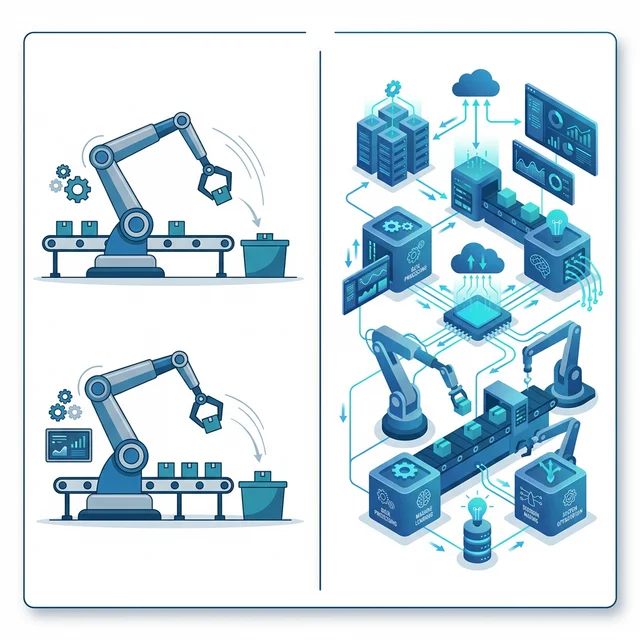

For decades, automation meant one thing: computers doing the same task in the same way, faster and more reliably than humans. Valuable, certainly — but fundamentally limited. A rules-based bot will process thousands of invoices identically, but the moment it encounters an unusual format or an edge case the programmer didn't anticipate, it fails or requires human intervention.
Intelligent automation changes this. By layering machine learning, natural language processing, and computer vision on top of traditional process automation, we create systems that can handle variation, learn from feedback, and improve their performance over time. This is not science fiction — it's happening in production systems today, across industries and at scale.
What Makes Automation "Intelligent"?
Traditional automation is deterministic: if X, then Y. Intelligent automation is probabilistic: it makes judgment calls based on learned patterns, and its accuracy improves as it processes more data. The key enabling technologies are:
- Machine Learning (ML): Systems that learn patterns from historical data and apply those patterns to new inputs — classifying documents, predicting demand, detecting anomalies
- Natural Language Processing (NLP): Understanding and generating human language — reading contracts, extracting information from emails, routing support tickets by topic and sentiment
- Computer Vision: Interpreting images and video — quality inspection on production lines, document digitization, invoice processing from scanned images
- Process Mining: Automatically discovering how processes actually work by analyzing system log data — identifying bottlenecks without manual observation
- Robotic Process Automation (RPA) + AI: Traditional RPA handles the interaction with systems; AI handles the judgment — together, they automate tasks that require both execution and cognition
Where Intelligent Automation Creates the Most Value
Document Understanding and Processing
Intelligent document processing can read invoices, contracts, purchase orders, and forms — extract relevant fields, validate them against business rules, and route them appropriately — regardless of format variations. A traditional rules-based system needs templates for each document format. An intelligent system reads documents the way a human does: understanding context, handling variation, and flagging uncertain cases for human review.
Predictive Maintenance
Rather than maintaining equipment on a fixed schedule (wasteful) or waiting for failures (expensive), intelligent automation monitors equipment sensor data in real time and predicts when maintenance will be needed — before failure occurs. This reduces unplanned downtime by 30–50% and cuts maintenance costs by 15–25% in typical industrial deployments.
Dynamic Pricing and Demand Forecasting
ML models can synthesize thousands of variables — historical sales, weather, competitor pricing, local events, social trends — to forecast demand and optimize pricing in ways no human analyst could match. Retailers using AI-driven demand forecasting typically reduce inventory carrying costs by 20–30% while improving in-stock rates.
Fraud Detection and Risk Management
Rules-based fraud detection flags known patterns. ML-based detection identifies unknown patterns that deviate from normal behavior — catching novel fraud schemes that no existing rule anticipated. Financial institutions using ML fraud detection consistently outperform rule-based systems in both detection rates and false positive rates.
"The question is no longer 'Can this task be automated?' Almost anything can be automated. The question is 'What happens when the automation encounters something unexpected?' Intelligent automation handles the unexpected."
The Human-Machine Collaboration Model
The most effective intelligent automation designs are not fully autonomous — they're collaborative. The AI handles the high-volume, repetitive, and data-intensive components while humans handle exception resolution, ethical judgment, and relationship-critical interactions. This human-in-the-loop model achieves higher accuracy than either humans or AI alone, because it combines machine speed and consistency with human contextual judgment.
As models improve with feedback, the human oversight required decreases — but the ability to escalate to human judgment remains an important quality and trust mechanism, particularly in regulated industries.
What Organizations Need to Be Ready
Implementing intelligent automation requires more than technology investment. The prerequisites:
- Quality data: ML models are only as good as the data they're trained on. Historical process data must be accessible, labeled, and representative.
- Change management: Employees whose workflows change need clear communication about why, what changes, and what they'll spend their time on instead.
- Model governance: AI decisions need to be auditable, explainable, and monitored for drift over time.
- Integration capability: Intelligent automation needs to connect with existing systems — ERP, CRM, industry platforms — through APIs or RPA.
The Competitive Timeline Is Shorter Than You Think
The organizations deploying intelligent automation today are not just improving efficiency — they're building a data asset and operational experience that compounds over time. Every process a model runs through makes it smarter. The organizations that start now will have training data, production experience, and operational confidence that late adopters will struggle to replicate quickly.
If you're exploring how intelligent automation could transform your operations, let's have that conversation. We help organizations across industries identify where AI-powered automation will deliver the clearest and fastest returns.